top of page


Statistics
(Taken from 2016 statistic polls)
-
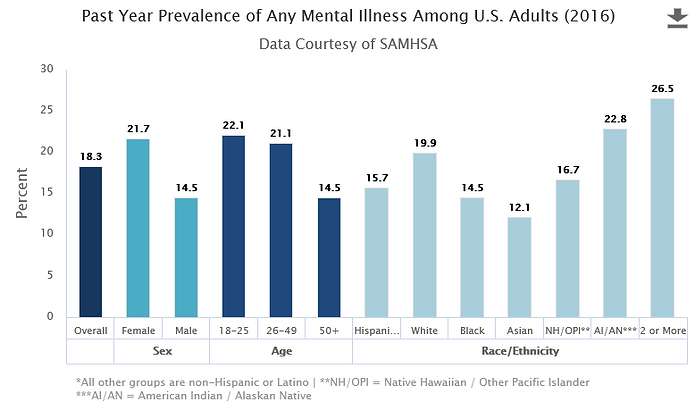
Approximately 1 in 5 Americans aged 18 and older presented with a mental illness (18.3%), that is over 44 million Americans
-
21.7% of women presented with a mental illness, compared to 14.5% of men
-
Adults aged 18-25 showed the highest prevalence of mental illness of all age groups (22.1%)
-
Mixed-race individuals showed the highest prevalence of mental illness compared to other racial groups
-
Of the 44 million Americans presenting with a mental illness, 43% received treatment in 2016
-
Women are more likely to receive treatment (48.8%), than men (33.9%) of those who have a mental illness
-
Adults aged 18-25 were less likely to seek treatment than adults aged 26-49
Statistics and graphics provided by NIMH, National Institute of Mental Health
Definitions
(Basic definitions of the most common mental illnesses and/or discussed or mentioned in the project)
Anxiety disorders:
Characterized by excessive fear or anxiety that is difficult to control and negatively and substantially impacts daily functioning.
Fear refers to the emotional response to a real or perceived threat while anxiety is the anticipation of a future threat.
These disorders can range from specific fears (called phobias), such as the fear of flying or public speaking, to more generalized feelings of worry and tension.
attention deficit
hyperactivity disorder (ADHD):
A persistent pattern of inattention (for example, difficulty keeping focus) and/or hyperactivity-impulsivity (for example, difficulty controlling behavior, excessive and inappropriate motor activity).
Children with ADHD have difficulty performing well in school, interacting with other children, and following through on tasks.
Adults with ADHD are often extremely distractible and have significant difficulties with organization.
Bipolar and
other mood disorders:
People with bipolar and related disorders experience atypical, dramatic swings in mood, and activity levels that go from periods of feeling intensely happy, irritable, and impulsive to periods of intense sadness and feelings of hopelessness.
-
Manic episode: abnormally elevated, expansive, or irritable mood accompanied by increased energy or activity that substantially impairs functioning
-
Major depressive episode: persistent depressed mood or loss of interest or pleasure
-
Mixed state: includes symptoms of both a manic episode and a major depressive episode
Depression:
Characterized by a sad, hopeless, empty, or irritable mood, and somatic and cognitive changes that significantly interfere with daily life.
Major depressive disorder (MDD) is defined as having a depressed mood for most of the day and a marked loss of interest or pleasure, among other symptoms present nearly every day for at least a two-week period.
Disordered Eating:
Can include behaviors that reflect many but not all of the symptoms of feeding and eating disorders such as anorexia nervosa, bulimia nervosa, binge eating disorder or other specified feeding and eating disorders.
Disordered eating behaviours, and in particular dieting are the most common indicators of the development of an eating disorder. Disordered eating has been linked to a reduced ability to cope with stressful situations, as well as an increased incidence of suicidal thoughts and behaviours (particularly in adolescents).
Post-Traumatic
Stress Disorder (PTSD)
Characterized as the development of debilitating symptoms following exposure to a traumatic or dangerous event.
These can include re-experiencing symptoms from an event, such as flashbacks or nightmares, avoidance symptoms, changing a personal routine to escape having to be reminded of an event, or being hyper-aroused (easily startled or tense) that makes daily tasks nearly impossible to complete.
Definitions provided by SAMHSA, Substance Abuse and Mental Health Services Administration, and the National Eating Disorder Collaboration
bottom of page