

Shannon
- Virginia Redlon
- Mar 13, 2018
- 6 min read

Updated: May 15, 2018
Above, former college softball player, Shannon Clancy describes her experience in a psych ward after a suicide attempt, the stigma she held herself before being admitted and how her time there changed her life.
Below, Shannon tells her story, including discussing how her mental health got to such a bad point that she attempted to take her own life, even after beating terminal brain cancer; and how professional athletes talking about mental illness is changing the game.
Shannon Clancy always knew she was different. Her mother would tell her stories of her childhood with her brother and sister, where the three would be sitting on the couch watching TV and while her siblings laughed at something on the screen, it took Shannon a moment before she would join them in their laughter.
“I would start laughing because they were laughing just because I kinda wanted to fit in,” Shannon said. That otherness continued into her school life, she says, feeling like an outcast, floating from friend group to friend group, always on the outside looking in.
As a high school senior in Babylon, New York, she first started noticing the signs that maybe she was not mentally well. Impersonating her mother on phone calls to the school, Shannon would excuse herself from classes three to four days at a time. Without the energy or motivation to even eat, Shannon would remain in bed.
These symptoms would continue, but Shannon, a softball player all her life, was excited to continue her career at Purchase College. In October 2014, her freshman year, Shannon was playing outfield at an off-season practice when she jumped up to catch a fly ball. As she made the catch, she fell, hitting her head on the top of the fence on the way down.
Diagnosed with a concussion at the hospital, the doctors made another shocking discovery.
After a CAT scan, doctors found a golf ball sized tumor on Shannon’s brainstem.
“I consider myself lucky because I had no idea it was there, until I actually got my concussion and got that CAT scan,” Shannon says.
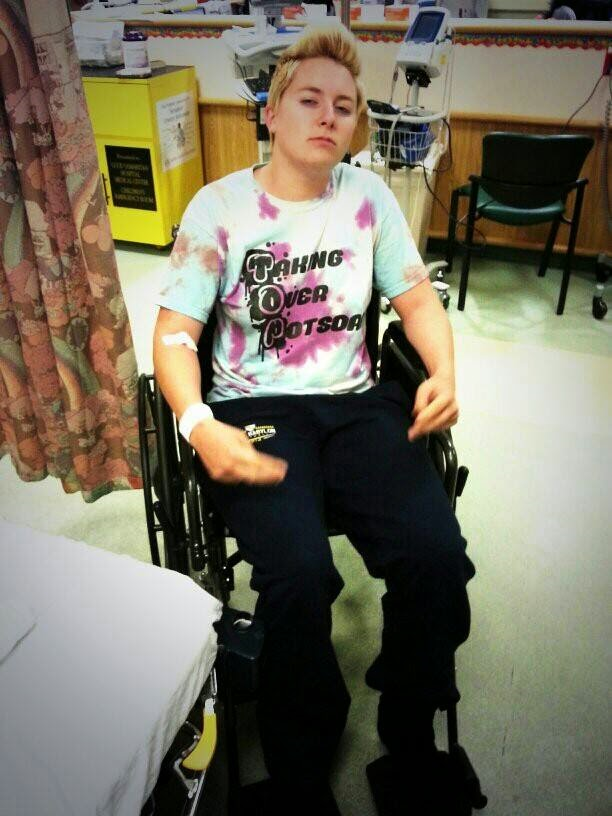
Inoperable due to the fragility of the brainstem, doctors recommended chemotherapy that would extend Shannon’s life another three years, compared to the one they gave her if she left the tumor untreated. She was 18 years old, and she had given up.
“I was talking to one of my classmates and I was just like, “I can’t do it. I’m not I’m not going to go through treatment just to extend my life,”” she said, “And she basically yelled at me, and she gave me this speech and it made me change my mind ultimately.”
One night, a few weeks into chemotherapy, Shannon spiked a 103 degree fever and feared for her life, “I remember going to sleep that night and genuinely thinking I may not wake up.” She recovered from that night, enough to continue playing softball that season in 2015, earning several Skyline Conference honors including 2nd Team selection starring in the outfield.

Throughout her treatments, Shannon tried to keep her sense of humor and continue living her life, though wearing a rainbow knit cap at almost all times. The hat now hangs as a relic on her wall at home. Despite her effort, Shannon felt understandably depressed, a symptom doctors told her may be another symptom both of the disease and the chemo, and of the emotional toll her situation was taking on her. But her incredible, high/manic points were not explained away.
During these treatments, Shannon received a call from her academic advisor at Purchase who had just watched a story on “60 Minutes”. The story was about a revolutionary new treatment Duke University was producing and studying for the exact terminal cancer Shannon was fighting. The treatment would see doctors drill into the patient’s skull to directly inject a genetically modified version of the Polio virus. It sounded crazy and scary to Shannon.
“My first thought was like, “I like my legs, I don’t want to lose my legs!” she says, “But I reached out to them and a few months later they agreed to do it.”
In December of 2015, Shannon flew from New York to Duke for the procedure. “The craziest part to me was that I was awake the whole time. They drilled into my skull and kept me awake. They drilled this hole and I sat there for 6 hours as the genetically engineered virus dripped in.”
The surgery was performed in just one appointment, and when Shannon returned to North Carolina four months later for a follow up the tumor had shrunken from the size of a golf ball to the size of a dime, and then was gone altogether.
“It seems like a nightmare and a dream wrapped up all in one,” she says, “I’m very lucky.”

Now cured, beating death, Shannon still experienced inexplicable highs and lows. She explains weeks where she had incredible energy, running on nights of 2 hours sleep, where she would join clubs and activities, spend all her money, tear apart her room, and go for jogs in the middle of the night. Those weeks would be followed by weeks of intense exhaustion. Unable to leave bed, like in high school, missing classes, Shannon would crash.
These symptoms, previously masked by cancer and its treatments, would cause Shannon to leave Purchase after her sophomore year in order to seek help.
It was three years after her initial cancer diagnosis, the amount of time the doctors had given her to live at the time, that Shannon decided to take her own life.
The attempt came in January 2018 after several bad events and struggles in her personal life; Shannon became overwhelmed with it all.
“I felt like I couldn’t come back from it. I just didn’t want to do it anymore,” she says.
Shannon took ten pills and drank half a bottle of vodka. She was unconscious before her mother walked into her room - something, Shannon says, she never normally does. It was luck, or intuition. An ambulance was immediately called, and Shannon, a trained EMT herself, vividly remembers hearing everything that was going on around her.
“They say the last thing you lose is your hearing and it is literally the last thing you lose. I was there, I didn’t feel much, I didn’t see anything but I remember hearing everything that was going on,” She said, “The EMT pinched me on the arm and my arm flinched and he said, “Responds to pain.” And that’s something I had learned in my EMT class and in that moment I felt like an idiot. But right then and there everything seemed doable.”
At the hospital, Shannon’s stomach was pumped and when she recovered she was transferred to Zucker Hillside, a psych ward in Queens, New York. Shannon admits that she held onto a stigma of psych wards and mental hospitals, before being admitted to Zucker Hillside.
“I was one of those people that was like, “Oh my God, they torture them to make them better. Like what a bunch of crazy people.” But I am crazy people.”
“It was a little weird at first but ultimately they turned my life around and gave me exactly what I needed, the perfect help. It changed my life, it saved my life actually,” she said of her time at Zucker Hillside, “You are surrounded by people who just want to help you, that’s their main goal, that’s why they work there. You are surrounded by college kids that are lost, and confused, and scared just as you are.”
While there, the hospital got a visit from famed New York Met and Yankee, Darryl Strawberry. Strawberry, throughout his career spanning the 1980s and 1990s, suffered from mental illness and addiction and is now in recovery from both. He is one of many athletes who has spoken out about their struggles, and is now an advocate for the discussion on mental health.
“After I left the hospital I looked into it and there’s tons and tons of athletes! Michael Phelps! I mean, so many struggle with it and it’s like we’re embarrassed to talk about it. It takes a lot to come forward,” Shannon says, comparing the struggle to that of coming out as a gay athlete, “It’s a struggle to accept it yourself. And then to come up and tell other people about it, that’s a whole other game.”
Shannon wants to destroy the stigma surrounding mental health and psych wards, she dreams of a day where people struggling with mental illness can be okay with it and go get help.
“The more we talk about it, the more it’ll be normalized and the more comfortable people will be to get help. There’s probably more famous athletes struggling with mental illness than we know about just because they don’t want to talk about it,” Shannon says, “Athletes are seen to be the most physically fit people alive, and that doesn’t mean they’re mentally as fit. They could be going through a war in their head, and we don’t know because we don’t talk about it.”
Through her struggles and her adversity, Shannon has always kept her sense of humor. And that rainbow hat. It serves as a reminder of what she has been through, and a reminder to keep the fight.
"I’m still struggling, definitely. There’s still ups and downs, but they’re better, they’re more controlled. I feel way more in control of my emotions than I have in my entire life. "
Thank you Shannon for sharing your story.

Comments